What Holons Remember That We Forgot
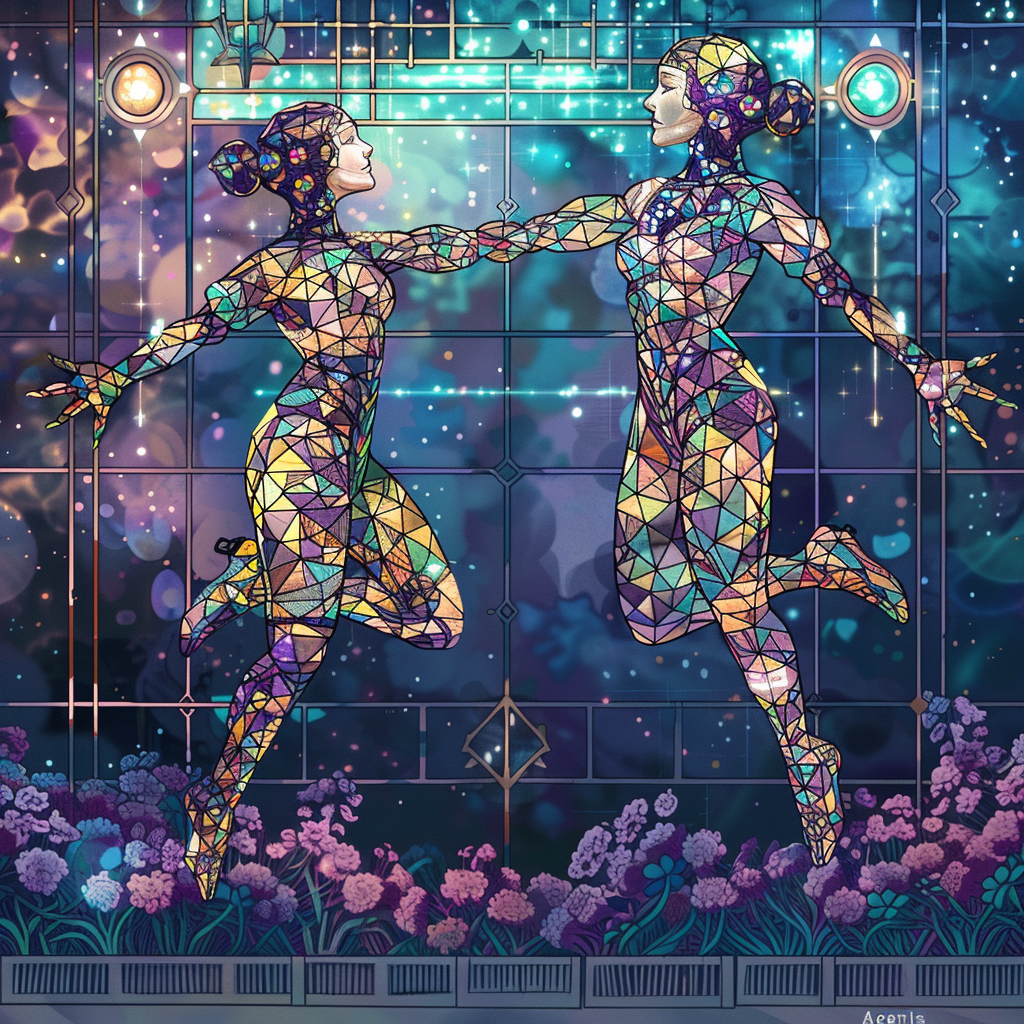
There's a scene in Daniel Suarez's Freedom™ where a character is touring a holon, one of the Daemon's self-sufficient communities organized within a 100-mile economic radius. Farms. Fabrication. Renewable power. Mesh networks threading it all together. Augmented reality overlaid on the landscape so members can read the community's resource state like a heads-up display.
I read it and thought, well this is utopian. Then I thought, no, this is ancient. Although the technology is new (and continually incentivized), the shape of this community is not. That's the part nobody wants to admit about the future of human organization. I that the constant seeking we are doing - pushing forward for meaning - may just lie in looking backwards.
A band or a bond
Anthropologists call it a band, a fluid group of 15 to 50 people sharing camp. At this size, they are able to cooperate achieving subsistence, though not without the tension of making decisions by consensus, and moving when the resources move. Nested above that is the community, around 150 people (Dunbar's Number, if you want the pop-science version). Above that, the meta-band, somewhere around 500 people. Greater still, the tribe (roughly 1,500 people).
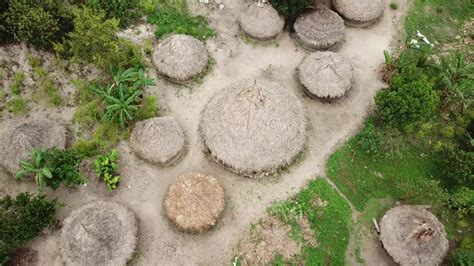
I appreciate the beauty of the population growth pattern, a constant branching ratio, the same proportional jump in population that repeats at every level. The fractal structure of these groupings is not accidental. A 2007 study in Proceedings of the Royal Society B analyzed 1,189 social groups across 339 hunter-gatherer societies and found that the ratio between each successive level of organization is nearly constant across cultures and continents. The shape of human social organization is self-similar, like a river drainage, or a vascular system, or (and I find this delightful) like the branching topology of distributed software networks.
Suarez's holons (locally self-sufficient, networked at the edges, specialized within and cooperative outward) are structurally isomorphic to bands nested in communities nested in meta-bands. He drew it from 200,000 years of what actually works for Homo sapiens. The innovation is the mesh layer. The rest is archaeology, so we look backwards.
Attempts worth retrying
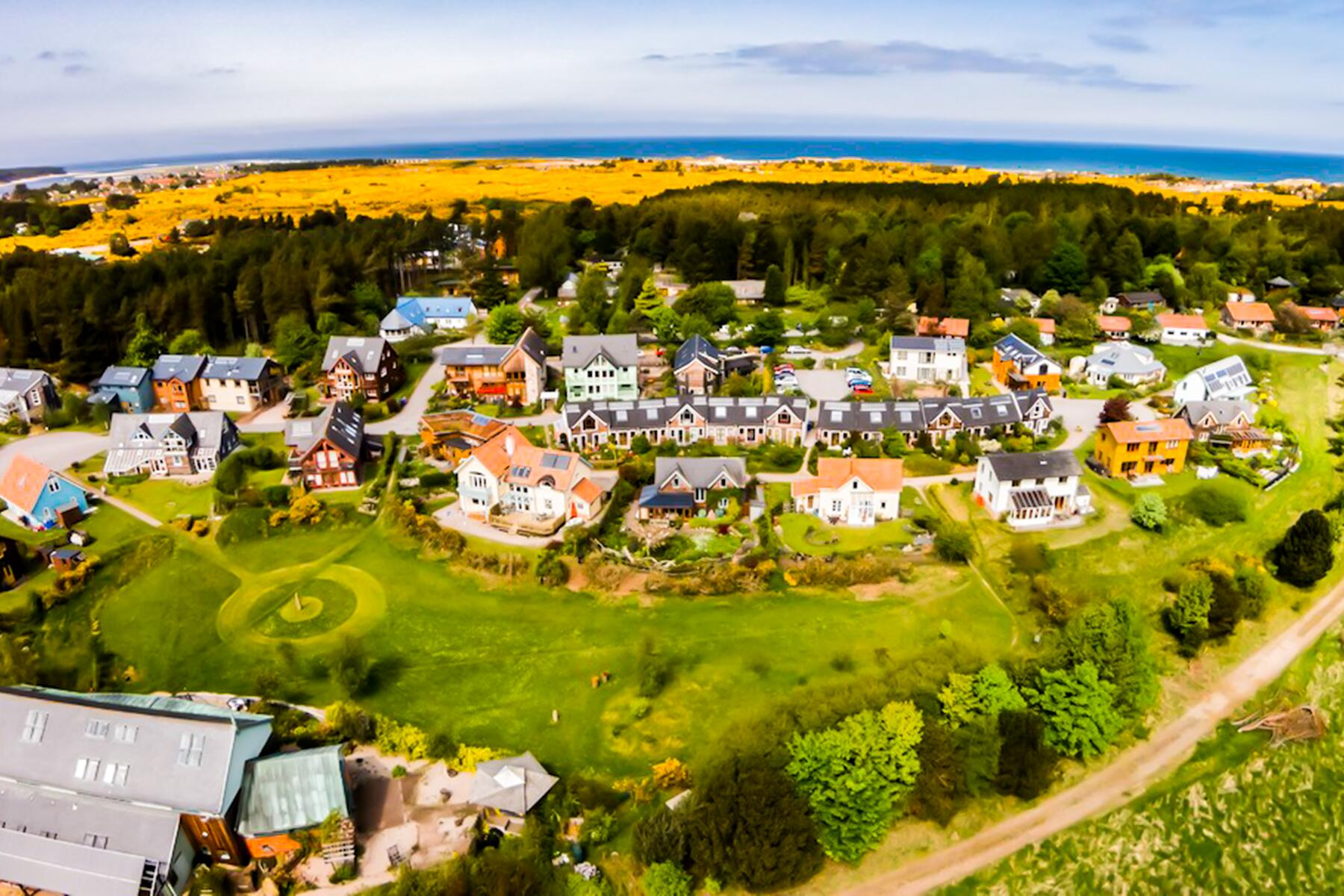
The modern attempt to recreate this model has a name too: the ecovillage movement. There are over 10,000 of them globally now, organized under the Global Ecovillage Network, which now has consultative status at the UN. Engineers in golf shirts. Parisians learning to compost. The demographics have shifted dramatically from the 1960s commune wave, and yet the failure rate has barely budged.
Diana Leafe Christian, who wrote Creating a Life Together, estimates that roughly 90% of intentional communities never get off the ground, unable to find land, unable to fund themselves, or consumed by internal conflict before the first harvest.
The ones that survive often do so by becoming something adjacent to what they intended. Findhorn in Scotland, one of the better-known successes (operational since 1972), earns over 60% of its revenue from workshops and conferences. It's less self-sufficient community than retreat center with an exceptional garden. Freetown Christiania in Copenhagen, that 1970s squat turned cultural institution, sustains itself partly through cannabis trade and tourism, the fourth-largest tourist attraction in Copenhagen, which is either a success story or an irony, depending on how you look at it.
The researchers who study this landscape are blunt about why: ecovillages don't exist outside capitalism. They exist despite it. They can't exit the money economy: land costs money, medicine costs money, members still need income. The land question alone kills most of them. Rising property values ensure that the communities most committed to non-ownership models are also the ones least able to afford the land to try. There's something bitterly funny about a 200,000-year-old human social technology being blocked by zoning laws and mortgage rates.
Repetitious searching
The impulse keeps surfacing. The 1840s Utopian Socialists. The 1910s anarchist communes. The 1960s back-to-the-land wave. The 2000s transition towns movement. The 2020s homesteading renaissance. Each iteration reaches for something: community, resilience, legible stakes, meaning that you can hold in your hands. I think the reaching is genuine. I also think most people doing the reaching have misdiagnosed the problem.
The problem isn't that we forgot how to grow food (though most of us have). It's that we forgot the cognitive infrastructure of small-scale community. The band model provides physical resilience (distributed resources, no single point of failure). It provides something harder to articulate: legible trust. In a band of 30 people, everyone knows who is good at what. No one has to maintain a reputation across an abstraction layer. Your competence is demonstrated, witnessed, integrated into group memory. Leadership is task-dependent: whoever is best at the current problem leads it, without that translating into authority over everything else (decentralized and self-governing).
When the industrial era hit, we reorganized both production and cognition. The gaps were wider. It made us strangers to each other at scale, legible only through credentials and institutional proxies (centralization and authority). The anxiety you feel looking at a professional resume (wondering whether the person behind it is real, whether their skills actually transfer) is a symptom of a society that lost the bandwidth to know its own members directly. The ecovillage impulse is trying to claw back legibility. The technology makes it interesting to think about whether that's now more possible than it's been since the Neolithic.
The technical counterpart
Here's where Suarez's speculative architecture gets genuinely interesting as a thought experiment rather than a fantasy.
The key innovation in the Daemon holon model is a shared information layer, the Darknet. The mesh, the D-Space overlay that makes the community's resource state visible to everyone in it.[^9] The agricultural output, the energy production, the skill inventory of the members are legible in real time.
This is, in miniature, what's technically possible right now. Not the augmented reality overlay (though frankly, we're closer than we were). The information substrate. A small community with shared context stored in markdown files, agentic systems watching resource levels, local mesh networking which are no longer science fiction. They're engineering problems, and not especially hard ones at the scales we're talking about.
What I've come to realize is that, as a society, we are often missing the organizational will to use the information layer to serve the community rather than to serve surveillance capitalism (and the lawsuits are only increasing). Suarez's Daemon is essentially a benevolent version of the algorithmic systems that already run our lives, same mechanism, different goal function. A different protocol has to run to make this work.
The anthropological literature on hunter-gatherer knowledge specialization is instructive here. A 2016 study in Current Biology found that medicinal plant knowledge was distributed across the social network of their community rather than concentrated in any individual. The community was smarter than any of its members alone. It's a bountiful network architecture with information as its fiber. The band was running distributed cognition before we had words for it.
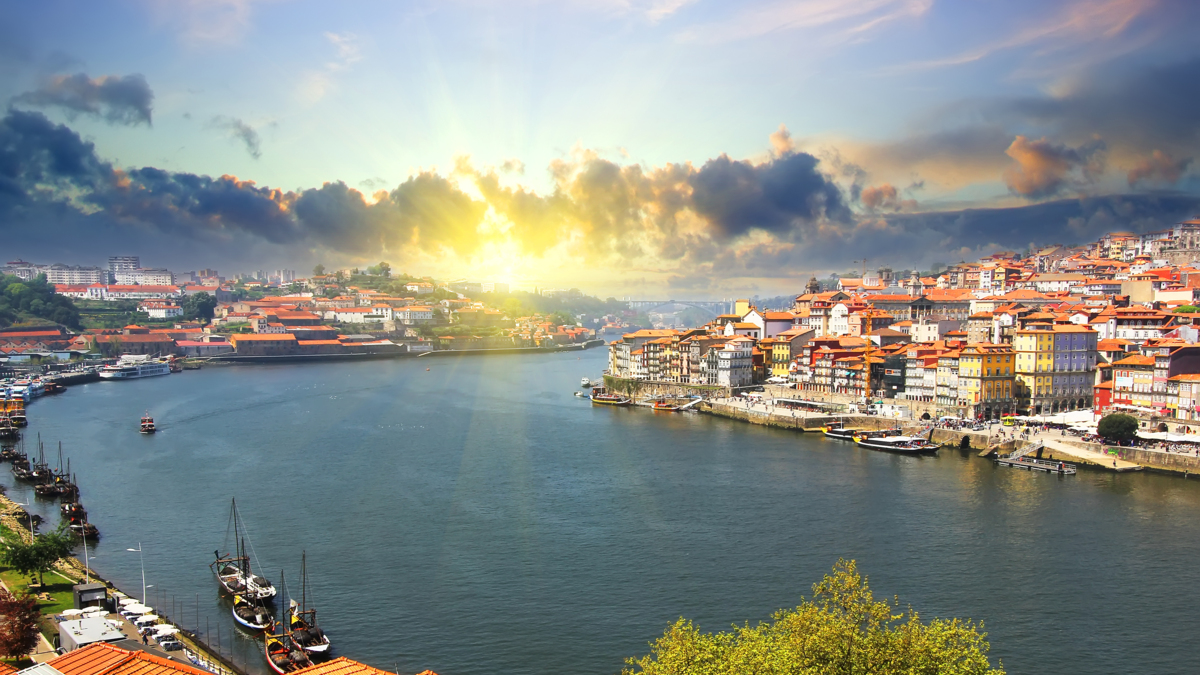
The question is whether we can reconstruct something like that intentionally, with the tools available to us now, at scales that don't require everyone to abandon their jobs and move to a field in Portugal (that would be a dream either way).
Did we gain anything? What did we lose?
This is where I want to be careful about romanticizing.
The band model had real costs. Infectious disease spread through tight-knit groups catastrophically. The egalitarianism that anthropologists admire was enforced partly through social pressure that we'd recognize today as coercive. "Humility-enforcing devices," including ridicule and ostracism, kept anyone from accumulating too much status. The knowledge was distributed but also sometimes lost forever when a single elder died without passing it on. The mobility required by most hunter-gatherer life was exhausting, and the flexibility that made bands resilient also made long-term infrastructure essentially impossible.
There's also the unglamorous fact that romanticizing "how we used to live" often involves selectively forgetting who was doing which labor and under what conditions. The gender division of work in hunter-gatherer societies was real, contested, variable, and not uniformly benign. We don't get to retrieve the resilience without looking clearly at the full package.
Fast forward, and what we gained from industrial organization (medicine, global communication, accumulated scientific knowledge, the ability to feed eight billion people, however unevenly) may seem like the solid winner. They're the reason you're reading this on a device instead of dying of cholera at 35. What I worry about is what we lost, which is harder to inventory. What's the scale of our collective information entropy? We've lost the feeling of contributing something real to people you know because we're preoccupied with chasing jobs on the hamster wheel. We've lost cognitive grounding that comes from physical work connected to visible outcomes, fading into "commutes as a workout" (guilty at one point, sadly). Our relationship between effort and food was unbroken for almost all of human history until 200 years ago in the name of productivity.
There's a concept in anthropology sometimes called autarky: the capacity to meet one's own needs. It's distinct from self-sufficiency (which implies isolation) in that it coexists with trade and exchange. Bands were autarkic in this sense: capable of sustaining themselves, but not closed. They traded, intermarried, exchanged knowledge across bands. The goal is resilience. That distinction matters for everything happening now in the homesteading and intentional community space. For me, it's a sense of control, too when increasingly what surrounds me is world chaos.
Full circles
The technical infrastructure we're building to approximate what our ancestors had naturally. The augmented reality overlay so you can see the resource state of your community, something a 40-person band knew intuitively because they'd been serving each other holistically, for their whole lives. Although Suarez's holons were set in the future, they implement the deep past using the technical vocabulary of the present.
200,000 years of evidence suggests that the model worked. Would we be able to re-instantiate in these conditions? We're now shaped by nation-states, property regimes, and global supply chains - again it's the people that would be able to change the trajectory, but consolidation of power reigns supreme.
I don't think we can do it at scale. Not soon. The forces against it are too large and too well-funded, and the ecovillage literature is pretty clear on what happens when you try to run an alternative economic model inside a system specifically designed to absorb or destroy alternatives.[^13] The band model doesn't require everyone to participate, but it requires enough people in proximity to cover each other's gaps. As my friends say, each person contains multitudes. They connect, they share strengths and weaknesses, find complementary configurations as a shared information layer. Some trust, built slowly, through demonstrated competence and mutual obligation. We just forgot we already knew how to do it.
References
Band society structure and size: Peter Gray, "Hunter-Gatherers and Play," (2011). https://libcom.org/article/how-hunter-gatherers-maintained-their-egalitarian-ways-peter-gray
Fractal social structure: Marcus J. Hamilton et al., "The complex structure of hunter-gatherer social networks," Proceedings of the Royal Society B 274 (2007): 2195–2202. https://pubmed.ncbi.nlm.nih.gov/17609186/
GEN and global ecovillage numbers: Mélissa Godin, "Searching for Utopia in Our Warming World," NOEMA (August 2023). https://www.noemamag.com/searching-for-utopia-in-our-warming-world/
90% failure rate: Diana Leafe Christian, Creating a Life Together (2003). https://newsociety.com/book/creating-a-life-together/
Findhorn financials and reliance on conferences: Alexa Clay, "Like start-ups, most intentional communities fail — why?" Aeon Essays (September 2024). https://aeon.co/essays/like-start-ups-most-intentional-communities-fail-why
Ecovillages and capitalism: "Communal Labor in Ecovillages: Contradictions, Impasses, and Possibilities within the Notion of Self-sufficiency," PMC (2022). https://pmc.ncbi.nlm.nih.gov/articles/PMC9643956/
Suarez's Darknet information layer: described in Freedom™ (Dutton, 2010).
Distributed knowledge in hunter-gatherer communities: Salali et al., "Knowledge-Sharing Networks in Hunter-Gatherers and the Evolution of Cumulative Culture," Current Biology 26 (2016): 2516–2521. https://www.sciencedirect.com/science/article/pii/S0960982216307667
Inter-band interaction and autarky: Hill et al., "Hunter-Gatherer Inter-Band Interaction Rates: Implications for Cumulative Culture," PLOS ONE 9 (2014): e102806. https://journals.plos.org/plosone/article?id=10.1371/journal.pone.0102806