When Self-Expression Becomes Distributed

Earlier this week, I was walking a friend through my homestead project. The shared agentic system my husband and I built to manage our five-year path toward self-sufficiency and general household things. This friend is a well-respected security engineer, researcher, and practitioner. Sharp mind. The kind of person who thinks in threat models and systems architecture.
As I explained the shared context layer, the way we use Claude instances as separate nodes feeding into a unified knowledge base, how we coordinate without duplicating effort I saw a lightbulb.
"That's TELOS work," he said. "Like what Daniel Miessler talks about."
I knew immediately what he meant. And I felt that small jolt of recognition you get when three independent threads weave together unexpectedly.
Here's the thing: I'd already been reading Daniel's work for some time. Genuinely starstruck by the notion of the connection, if I'm being honest. The kind of starstruck where you read something and think, "This person has articulated something essential." It felt like another Node being added to my network through seeing TELOS in what my husband and I had built.
I'd arrived at these ideas through necessity and iteration on the homestead. Daniel Miessler, whose framework for TELOS work—for understanding human purpose and meaning in an age of AI—had been bookmarked as a mind-changing read, suddenly wasn't just a theoretical reference. He was a bridge.
Not because we were racing toward the same idea. Because we'd arrived at it from completely different directions, and suddenly it became clear: we were all thinking about the same problem.
That moment stuck with me. Because he wasn't just confirming what I was doing. He was reframing it. And in that reframing, something that had felt pragmatic and local suddenly connected to something much larger—a philosophy about meaning, agency, and what it means to do work that actually matters.
This is about exploring that three-way conversation. About what happens when Daniel Miessler's framework for TELOS work encounters a system that's fundamentally collaborative. About what changes when self-expression becomes distributed across multiple human nodes.
What Daniel Miessler Is Actually Talking About
If you haven't encountered Daniel's work, [start here]. But let me sketch the outline, because it's crucial to what comes next.
Daniel describes three eras of human organization. Human 1.0 is survival. Most people die from starvation, disease, violence. Human 2.0 is the corporate era, where capitalism and science create material abundance but trade it for a different kind of captivity: you're defined by your value to an employer. Better than 1.0, but not free.
Then something interesting happened. Religion stopped being the primary source of meaning for most people. Science provided better explanations for why things worked. In ejecting the faulty frameworks, we also ejected the meaning those frameworks provided. And we didn't replace it.
We filled that hole with work. For most of the 20th century, work became the answer to "what am I supposed to be doing with my life?" But that's fragile. And now it's breaking.
He calls what's coming next Human 3.0
It's the Creative Era: where we stop being workers and consumers, and start being something else entirely. People who understand themselves primarily as unique individuals with something to offer the world. People who articulate the problems they want to solve. People who spend their time improving themselves and creating value that only they can create.
In his framework, this is where freedom actually becomes possible. Not the freedom from constraint (you'll always have constraints). But the freedom to choose your constraints. To define yourself by what you make, not what you're paid to do.
He calls this TELOS work. Telos is an ancient concept—the end or purpose toward which something naturally aims. Your TELOS is the thing you're built to do. The problem you're wired to solve. The gift only you can give.
And here's the thing he emphasizes: this isn't new. People have been doing TELOS work forever. Artists, craftspeople, researchers, builders. But what's new is the possibility for billions of people to do it simultaneously, because technology and automation are stripping away the need for the drudgery.
The question becomes: what will you actually do with that freedom?
Where The Framework Breaks (In The Best Way)
I've followed Daniel's work for some time. His recent piece on the AI bubble and labor got under my skin in the way only clear thinking about uncomfortable things can. He's exploring the root of humanity's intersection with technology and society. The meaning crisis compounded by job displacement. The fact that we weren't supposed to be doing these jobs anyway.
All of that resonates. Deeply. I'm literally working towards touching grass with this homestead project. The goal is to actually return to the earth and personhood. Alas, I digress.
His vision of Human 3.0 is profoundly individual. You articulate your TELOS. You create your unique value. You resonate at your frequency. It's beautiful. However, it's fundamentally about individuals expressing themselves into the world.
What happens when two (or three or four?) people with completely different cognitive styles, different expertise, different strengths decide to pursue TELOS work together?
That's where my system enters the picture.
The Pragmatic Problem That Led Somewhere Bigger
Self-sufficiency is a misleading term. What we actually need is collective self-sufficiency. No single household can produce everything. Some resources are seasonal. Some require scale. Some require expertise that takes decades to develop. The question isn't "how do we need nothing from anyone?" It's "who can we trust enough to depend on, and what do we offer in return?"
This is why Node 2 exists. The in-laws' property, 5 miles away. Two people with completely different expertise and backgrounds: one who grew up canning on a farm, who teaches food preservation, who understands the work of making food safe across seasons. The other with policing and security knowledge, with a different way of thinking about risk and systems.
On paper, that's just proximity and goodwill. It’s actually deeper.
We plan to build separate Claude instances for each household (node). They both feed into the shared context layer. An Obsidian vault encrypted on Proton Drive, this time with Tailscale and local model processing. Eventually we may expand this to a longer term storage but the unique capabilities of Obsidian outweigh the switch for now. The AI is holding shared context across physical distance. It's helping translate between strategic thinking and operational constraint - it is a Node in and of itself. It's infrastructure that lets two different households work at the same problem without losing coherence.
What makes it meaningful is that trust has to be legible to function at scale.
Shared context means shared risk, shared planning, shared understanding of what we're actually building. It means if one node has a breakthrough on a novel way to keep our future goats from eating everything, all nodes benefit immediately (and instantly?). If one node faces a resource constraint, both can think about how to solve it. The Node 2 expertise in food preservation becomes part of the network system. The Node 1 strategic capacity becomes available to Node 2's operations. Behold! Collaborative TELOS at work.
The System: Multi-Node Network
Let me show you the shape of how this actually works across the two-node distributed network:
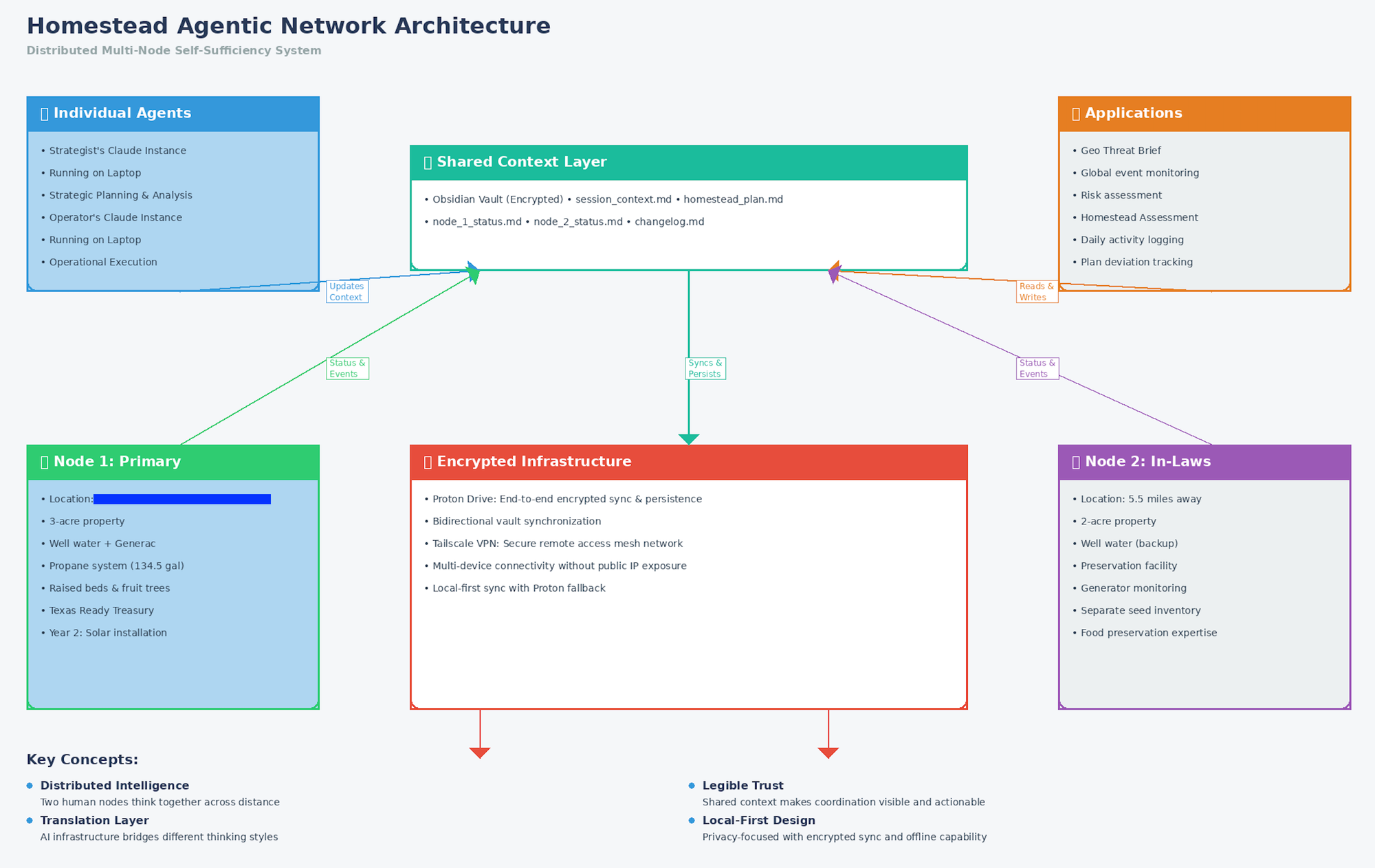
This isn't a centaur system (h/t Ethan Mollick - another one for good reads) . That would be one human plus one machine. This is something different: two physical nodes across a distributed network, with AI holding shared context across both.
Both individuals maintain separate Claude instances. Both can access both applications. The shared Obsidian vault captures status from both nodes: propane levels, preservation throughput, water backups, generator maintenance schedules. Neither node is subordinate to the other but intertwined with social trust encoded in markdown.
Node 1 ↔ Node 2 Coordination
It's late summer. Node 2 has fruit and preservation capability. Node 1 has the strategic inventory tracking. Apples, peaches, grapes coming in. Node 2 logs: "Preservation activity: 5 lbs apples canned, +12 oz grape juice. Generac runtime: 2.5 hours (fuel consumption logged)."
This single entry flows into the shared context:
- Node 2 status: Preservation throughput against Year 1 targets
- Fuel tracking: Generator data feeds into propane reserve calculations
- Five-year plan: Does this preservation rate meet Year 2 targets?
The strategic mind sees the pattern: "If Node 2 maintains this throughput, preservation targets move forward one quarter." The operational mind sees real-time constraints: "Generac fuel consumption is higher than projected. Order next fill earlier than planned."
Neither person is commanding the other. They're reading shared context and adjusting their own domain. Translation happening in real time.
The Difference Between Coordination and Resonance
This is the part that connects back to Daniel's framework in a way that becomes clear through building this kind of system.
In the corporate era (Human 2.0), the answer to "how do multiple people work together?" is organizational structure. Hierarchy. Role definitions. Quarterly planning cycles. The system assumes that people are interchangeable, that what matters is the output, not the alignment of meaning.
In a centaur model (human + machine), one is still essentially one person. Augmented with computational power. More efficient. But not fundamentally different.
What exists here is something else. It's what happens when two people (two families!) with different cognitive styles, different expertise, and different ways of being in the world decide to pursue something meaningful together—and use AI as the translation layer instead of the decision-maker.
That's TELOS work. Collaborative TELOS work. Four people resonating at their own frequencies while simultaneously amplifying each other.
Daniel talks about this vision of Human 3.0 as "billions of people doing this"—expressing themselves, creating value, getting lost in work they love. He references a video of someone making coffee with such care that every element (camera work, fonts, music, captions) is an expression of self. It's not just useful; it's a gift.
What if? Imagine billions of people doing this together. Not competing. Not hierarchically organized. But genuinely collaborative. Each person resonating at their own frequency while being in genuine relationship with others' frequencies.
Exerting Capabilities In Your Locus of Control
So why does this matter beyond intellectual elegance?
I can't solve the meaning crisis. I can't fix the labor displacement that AI is going to cause. I can't restructure society into Human 3.0. Here's the thing. I have a locus of control. My partner has a locus of control. We have a shared locus of control: this five-year journey toward food and energy independence.
Within that circle, I can exert capabilities where I have them. I can think strategically. I can build systems. I can use AI as infrastructure rather than oracle. I can learn to code if it serves the work. I can tend to the epistemic integrity of our shared knowledge.
My husband can exert his capabilities. He can build and execute. He can think about how our garden should be structured, where the hydroponics would route, and every heirloom seed is catalogued (years of Sim City, Warcraft, and Stardew Valley can do that to you). He can create beauty in the process because how something is done matters as much as whether it gets done.
And we can do this together, in a way that amplifies both of us, because we have infrastructure that makes our different ways of thinking legible to each other.
That's not revolutionary. It's deeply mundane. A propane receipt. Beans low in inventory. Solar timing for next year. The unglamorous stuff of actual self-sufficiency. It's also exactly what Human 3.0 could look like if you're willing to do the work to build it locally. Just two people saying: "Here's what we're trying to do. Here are the tools available to us. Let's be intentional about how we use them."
The work stops feeling like coordination—where one person directs and another executes. It becomes translation. It becomes resonance.
There's a concept from Orson Scott Card's Ender's Game that maps here: the auias. In the Formic Wars, individual ships commanded by capable pilots were effective, but they were isolated. The breakthrough came when humans realized they could fight as distributed nodes—multiple ships thinking together, not as a hierarchy, but as a coherent intelligence distributed across space (a coordinated swarm).
That's not quite what's happening here. But the principle resonates. Multiple people, different ways of thinking, genuine coordination without homogenization. Not one mind commanding others. Multiple minds translating to each other.
That's what distributed TELOS work looks like. Not billions of individual creative geniuses. Billions of people finding others they can resonate with. Building infrastructure that makes their different ways of thinking legible to each other. Exerting capabilities where they exist. Creating meaning together.
The Question That Remains Open
My friend's observation—that what we're doing is TELOS work—is still sitting with me. We are demonstrating something about what TELOS work could look like when it's plural instead of singular.
And that matters because the conversation about meaning, about AI, about what we're actually trying to build—that conversation assumes we're solving for individuals. Humans don't actually work that way. We work in relationship. We think better together. We create more meaningful things when we have genuine collaboration instead of hierarchy.
So the question becomes: what does TELOS look like when it's distributed? When it's multiple people, each resonating at their own frequency, but genuinely amplifying each other?
I don't have the full answer yet. We're still building the system. But I know it starts with infrastructure that translates between different ways of thinking. With AI that holds context instead of making decisions. With the radical act of exerting capabilities where you actually have them, together, in the circle you can control.
That's the homestead. That's the system.
To me, it's beginning of something that feels, to me, like actual freedom.
Resources
- Daniel's TELOS section: Deeper exploration of purpose and meaning
- His Framing essay: On how perspective shapes what we see (relevant to how we translate across thinking styles)
- The AI Bubble is Labor — On the meaning crisis and what's actually happening
This essay is part of Deep Familiar Ground — a series on distributed nodes, earned trust, and the quiet work of building systems that don't fall apart when you're not watching.